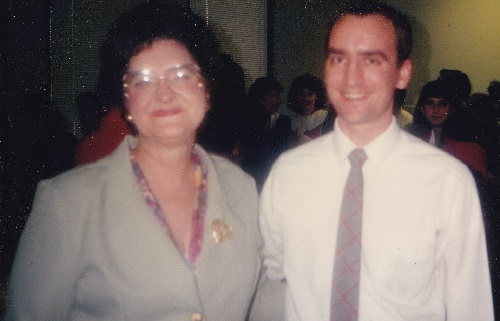
Over the last several days, I’ve heard many stories about Aunt Maurine — some I’d heard before and a few I hadn’t. Most centered on the qualities everyone knew. She was a wonderful cook.
She and Uncle Monroe were the unofficial hospitality committee for Dutchtown and County Line Church. She welcomed people easily and made them feel at home. Others have said those things more eloquently than I could.
But I may know something about her that many don’t — the story of a young girl born into a home with no electricity who eventually found herself in the captain’s chair of one of the highest-volume computer systems in the world. And it’s a story worth telling.
When I first started as a programmer at Delta, our desks didn’t hold sleek laptops or glowing monitors. The closest thing to technology on my desk was a Pentel mechanical pencil. We wrote programs by hand — literally — on 80-column coding sheets. Those sheets were sent to Keypunch, where operators typed each line into a keypunch machine. Every line of code became a separate punched card.
I’ve read that an acceptable error rate for a typist is three errors per hundred words. For a keypunch operator, the acceptable number of errors was none. Ever. Typists type words because they read words. Keypunch operators typed characters. And in programming, one incorrect character on one card could cost a programmer an entire day of work. I lost plenty of days to mistakes in those early years. None of them were ever caused by a keypunch error.
By the mid-1980s, we began receiving early IBM personal computers. As technology evolved, the need for keypunch operators slowly disappeared. That raises a hard question: What do you do when the job you’ve mastered is no longer needed? Some people resist. Some retreat. A few reinvent themselves. Aunt Maurine was one of the few. In her 50s — an age when many people are counting down toward retirement — she chose to learn something entirely new. She became a computer operator. I can’t say I was surprised. This was the same woman who, as a young girl, stepped up to run a household when her parents had to work outside the home. Responsibility had never intimidated her.
The computer room was a restricted area. As a programmer, I didn’t have access unless someone let me in. But I was there more often than most, and I would see her inside — mounting tapes, running jobs, watching the system carefully. It may have looked routine from the outside. It wasn’t. When the system went down, everything changed. All eyes turned to the computer operator. They were responsible for getting the system back online. And the pressure was intense.
If you’ve ever watched the national debt clock ticking upward by the second, imagine a similar counter measuring lost revenue every moment the system was down. That’s the kind of pressure that filled that room during an outage. There was no applause. No spotlight. Most people in the company never saw her tucked away behind those restricted doors. But they depended on her every day
Technology wasn’t the only transition she faced with grace. When the time came for her to move into assisted living, she posted this on Facebook:
“Well, I am at my new home. It is really nice and the staff is really nice and helpful. The food is very good and the residents are very friendly.”
No complaint. No self-pity. No drama. Just the same steady voice. She acknowledged the change. She found the good. She moved forward. That, too, was resilience. The same woman who once mastered keypunch machines and mainframe operations approached assisted living the same way she approached everything else in life: assess the situation, adjust, carry on. And now she has made one more transition — into her heavenly home. If she could make one more Facebook post, it might read like the one I quoted above, perhaps with a few more adjectives that couldn’t fully describe her final home.
There’s a symmetry to her life that strikes me now. A young girl born into a home without electricity. A mature woman responsible for keeping a mission-critical computer system running. From running a household to running mainframe operations. From welcoming neighbors at church to quietly serving an entire company from behind the scenes. From adapting to technological revolutions to adapting to life’s final seasons.
“She stood in the storm and when the wind did not blow her way, she adjusted her sails.”
— Elizabeth Edwards
That line describes her better than anything I could add.
The photo above is from her retirement party in December of 1992 and I was proud to celebrate it with her. It captures a milestone, but it doesn’t fully capture the quiet strength, precision, humility, and resilience that defined her life. We all remember her hospitality, but I also remember her steadiness under pressure — in the computer room, in life’s transitions, and even in her final season.
And that is a legacy worth celebrating.